![[Previous]](../prev.gif) |
![[Contents]](../contents.gif) |
![[Index]](../keyword_index.gif) |
![[Next]](../next.gif) |
|
|
|
|
 |
This version of this document is no longer maintained. For the latest documentation, see http://www.qnx.com/developers/docs. |
Spawn a child process, given a list of arguments and an environment
#include <process.h>

int spawnle( int mode,
             const char * path,
             const char * arg0,
             const char * arg1...,
             const char * argn,
             NULL,
             const char * envp[] );
variable=value
that's used to define an environment variable.
libc
Use the -l c option to qcc to link against this library. This library is usually included automatically.
The spawnle() function creates and executes a new child process, named in path with NULL-terminated list of arguments in arg0 ... argn and with the environment specified in envp. This function calls spawnve().
 |
If the new child process is a shell script, the first line must start with #!, followed by the path and arguments of the shell to be run to interpret the script. The script must also be marked as executable. |
The spawnle() function isn't a POSIX 1003.1 function, and isn't guaranteed to behave the same on all operating systems. It builds argv[ ] and envp[ ] arrays before calling spawn().
To view the documentation for a function, click its name in this diagram:
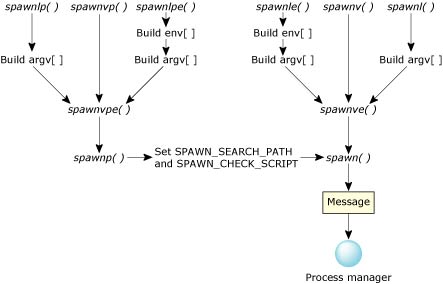
Most of the spawn*() functions do a lot of work before a message is sent to procnto.
Arguments are passed to the child process by supplying one or more pointers to character strings as arguments. These character strings are concatenated with spaces inserted to separate the arguments to form one argument string for the child process. At least one argument, arg0, must be passed to the child process. By convention, this first argument is a pointer to the name of the new child process.
If envp is NULL, the child process inherits the environment of the parent process. The new process can access its environment by using the environ global variable (found in <unistd.h>).
|
A parent/child relationship doesn't imply that the child process dies when the parent process dies. |
The spawnle() function's return value depends on the mode argument:
| mode | Return value |
|---|---|
| P_WAIT | The exit status of the child process. |
| P_NOWAIT | The process ID of the child process. To get the exit status for a P_NOWAIT process, you must use the waitpid() function, giving it this process ID. |
| P_NOWAITO | The process ID of the child process, or 0 if the process is being started on a remote node. You can't get the exit status of a P_NOWAITO process. |
If an error occurs, -1 is returned (errno is set).
Run myprog as if the user had typed:
myprog ARG1 ARG2
at the command-line:
#include <stddef.h>
#include <process.h>

char *env_list[] = { "SOURCE=MYDATA",
             "TARGET=OUTPUT",
             "lines=65",
             NULL
            };

spawnle( P_WAIT, "myprog",
    "myprog", "ARG1", "ARG2", NULL,
     env_list );
The program is found if myprog is in the current working directory. The environment for the child program consists of the three environment variables SOURCE, TARGET and lines.
| Safety: | |
|---|---|
| Cancellation point | Read the Caveats |
| Interrupt handler | No |
| Signal handler | No |
| Thread | Yes |
If mode is P_WAIT, this function is a cancellation point.
execl(), execle(), execlp(), execlpe(), execv(), execve(), execvp(), execvpe(), getenv(), putenv(), setenv(), spawn(), spawnl(), spawnlp(), spawnlpe(), spawnp(), spawnv(), spawnve(), spawnvp(), spawnvpe(), wait(), waitpid()
|
|
|
|